How to Support Local Restaurants Through Food Travel
Support local restaurants and revive local tourism. See how food travel boosts the local economy, plus how to plan your own hidden-gem restaurant route.
How Supporting Local Restaurants Revives Whole Neighborhoods — and Fuels a Tourism Boom
Every weekend, the same question comes up: "Where should we go this time, and what should we eat?" More and more, the real star of a great trip isn't the famous landmark on the postcard — it's the tiny, unassuming eatery tucked down a side street. The idea that a single beloved local restaurant can become the "clutch player" that saves an entire neighborhood keeps popping up in travel and food content, and it comes with a hopeful side effect: when these little spots thrive, local tourism warms up right along with them.
You've probably seen it yourself. A food show features a family-run kitchen or a hole-in-the-wall grill, and suddenly there's a line down the block. A quirky neighborhood spot serving something unexpected — handmade paella, a regional barbecue specialty, a decades-old noodle recipe — gets rediscovered and goes from "forgotten corner" to "must-visit destination." That arc, from struggling to survive to becoming the anchor of an entire district, doesn't feel like someone else's story anymore.
In this post, I'll break down why local restaurants are suddenly being treated as the secret weapon of regional tourism, and — more practically — how travelers like you and me can enjoy a rewarding food trip and help keep these neighborhoods alive at the same time. The best part: when you learn to support local restaurants the right way, you get a better trip out of it too.
Why "Local Restaurants as Neighborhood Saviors" Is Having a Moment
Rural decline and the slow death of small-business districts aren't abstract headlines anymore. In towns where people are moving away and foot traffic has dried up, when a long-standing, generations-old restaurant finally closes its doors, it isn't just one kitchen going dark. The customers who used to travel in to eat there disappear too — and so does the momentum for the market stalls, cafés, and shops that lived off that same crowd. In other words, an entire pocket of local tourism shrinks all at once. That's the vicious cycle.
Flip it around, and the story changes completely. When one restaurant takes off, travelers start saying, "We came for the food, then wandered around and discovered the whole area." Money begins circulating through the entire district. This is exactly why food-lovers talk about a great restaurant acting as an anchor — a fixed point that pulls people into a neighborhood they'd otherwise never visit. "One good restaurant can revive a whole street" isn't hype; it's shorthand for the way a single business's revenue spills over into every shop around it.
That's the power behind the "neighborhood savior" framing. A local eatery on the brink of closing reopens to a full house, and that warmth spreads outward into the surrounding tourism economy. It's the classic image of a relief pitcher jogging out to the mound with the game slipping away — and, one out at a time, flipping the momentum. One small kitchen can change the mood of an entire district. And when we choose to support local restaurants, we're essentially handing that pitcher the ball.
 Charming street view of a traditional Korean restaurant facade in Seoul. (Photo: Huy Phan / Pexels)
Three Ways a Great Restaurant Warms Up Local Tourism
First, the chain reaction of spending. When a food traveler rolls into a neighborhood, they don't open their wallet just once. Lunch at the old family-run spot, dessert at a café down the block, fresh produce from the traditional market on the way out — one purchase pulls the next along behind it. Districts where restaurants, cafés, and markets are all within walking distance see an especially strong ripple effect. And if a single-day food trip turns into an overnight stay, the impact multiplies again. This is why the simple act of choosing to support local restaurants sends waves far beyond the dinner table.
Second, content spreads and puts the whole area on the map. Travel today doesn't end when the meal does — it lives on in photos and short videos. A neighborhood joint serving an unexpected regional dish, an old grill house doing one thing perfectly, gets shared across social feeds, and suddenly a wave of "I have to try that place" travelers follows. Over time, the neighborhood's own name becomes a food brand. The line that forms outside a spot the day after it appears on TV runs on exactly the same mechanism: exposure creates curiosity, and curiosity creates crowds.
Third, a virtuous loop that reaches all the way back to producers. When a local restaurant cooks with seasonal ingredients and specialty products from its own region, the money a customer spends on dinner eventually flows back to nearby farms and fisheries. A traveler's single satisfying meal turns into real income for the people who grew and caught the food. That's the quiet magic here: to support local restaurants is to support the entire supply chain behind them. In this way, a beloved local spot carries that warm current in three directions at once — tourism, small business, and local production.
So Who Actually "Saves" These Local Restaurants?
The most visible saviors are food influencers, YouTubers, and TV programs. When a popular show shines its light on a hidden gem, customers can flood in overnight. The discovery effect is undeniably powerful. But it has a catch. Plenty of places boom for a week or two, then empty out the moment the spotlight moves on. Exposure is a spark, not a life-support machine — visibility alone won't keep a restaurant alive for years.
Policy and local government play a big role too. Farmers-market programs, culinary-tourism campaigns, and small-business revitalization projects all help prop up neighborhood spots. What's fascinating is that the success stories tend to have one thing in common: they center people, not fancy infrastructure or new facilities. The most durable local food scenes are built by the hands of the people who actually live there. Shiny buildings fade; committed communities don't.
And finally — maybe most importantly — the ultimate savior is each individual traveler. A TV feature lights the fire, but the person who keeps it burning is the customer who comes back and tells a friend. "I tried it once and honestly it was great — I'd go again." When enough people feel that way, a restaurant survives. Loud, one-time exposure is nice, but quiet regulars are what truly keep a place standing. So the most reliable way to support local restaurants isn't a viral post — it's a return visit.
How to Plan a Local Food Trip That Never Disappoints
The most common mistake is bolting straight to the chain restaurant at the entrance of the tourist zone. If you've already traveled all that way, the whole point is to find the spot where the locals actually eat. The trick is simple: on your map app, read the content of reviews instead of just the star rating, and skip the places plastered all over TV and blogs in favor of the ones neighbors quietly recommend. In districts with dense, tangled alleys, the real treasures are usually hidden in the back lanes, not on the main drag.
For your route, I recommend a half-day walking loop. Warm up in the morning with a few snacks at the market, sit down for a hearty lunch at the signature old-school spot, grab dessert at a nearby café, then swing by a specialty-goods shop on your way out. Stringing the market, the classic restaurant, and the local products into one continuous walk makes the strolling and the eating equally fun — and naturally spreads your spending across the whole neighborhood. It's the easiest way to support local restaurants and their neighbors in a single afternoon.
Finally, don't skip the "wasted-trip prevention" checklist. Confirm these four things before you go: ① break times and closing days (many old-school spots close on Sundays or Mondays), ② whether there's a wait and whether reservations are possible, ③ payment methods (some cash-only places still exist), and ④ parking availability. Checking just these four things dramatically cuts down on the heartbreak of arriving to a locked door. A local food trip pays you back in exact proportion to how well you prepared.
"Conscious Consumption": The Traveler's Version of Support
The same meal can carry very different weight. Spending that ends with a single photo leaves nothing behind, while spending that turns into a return visit genuinely strengthens a business. That's the heart of the whole "neighborhood savior" idea: a brief rush matters less than a handful of customers who keep coming back. If a place won you over, stopping by one more time on your next trip is the surest form of encouragement there is — and the most meaningful way to support local restaurants long term.
Even your payment method can help. In many regions, using a local or community currency earns you a discount or cashback while keeping that money circulating inside the local economy. Paying at a traditional market with community currency instead of a card lets you pocket a perk and ease the transaction fees a small shop has to eat — a win on both sides. Before you travel, it's worth checking whether the area you're visiting issues its own local currency and where you can spend it.
And never underestimate the weight of a single review. A giant chain doesn't flinch at one bad star, but a tiny shop surviving on a few dozen loyal customers can win a stream of new visitors from one thoughtful, detailed write-up. Describe what you loved in specifics; post a nicely shot photo. These small acts add up, keeping local food travel sustainable — and quietly turning you into one of the savers who keep these places alive.
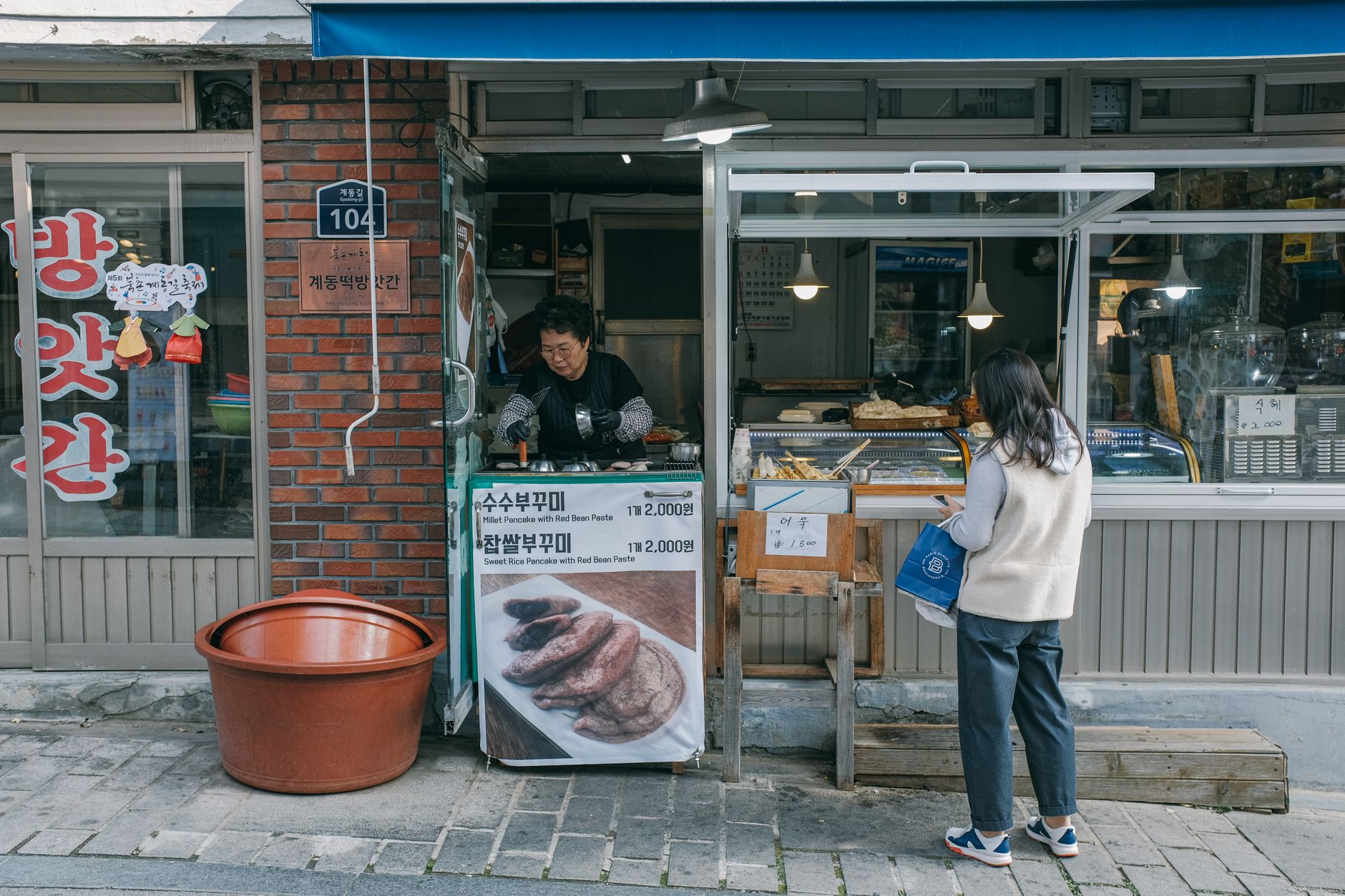 A woman purchasing street food from a vendor in Seoul, capturing urban life. (Photo: Huy Phan / Pexels)
Frequently Asked Questions (FAQ)
Q: What exactly does it mean to call a local restaurant a "neighborhood savior"? A: It's a baseball metaphor — the relief pitcher who comes in with the game slipping away and turns it around. Here it describes anything that revives a struggling local eatery and, by extension, breathes life back into the surrounding tourism economy. That "anything" might be a TV feature, an influencer's discovery, a local government campaign, or a repeat traveler. It's not one specific person — it's the whole catalyst that pulls a business and its district back from the brink.
Q: How do I tell a tourist-trap restaurant apart from a genuine local one? A: A few practical signals. ① The share of local customers — lots of longtime regulars and neighbors is a strong sign of quality. ② Menu focus — a place that concentrates on a few signature dishes usually beats one with an enormous, photo-heavy menu. ③ Signage and location — a spot that has survived for years down a back alley is more likely to be the real deal than a flashy corner unit on the main road. ④ Whether it's busy on ordinary weekdays, not just during peak tourist season. That last one is the clearest tell.
Q: Does eating at these places really help the local economy? A: Yes, it genuinely does. Spending that starts at one restaurant ripples out to cafés, markets, and lodging, and repeat visits plus word of mouth bring in new customers without a cent of advertising. Paying with a local currency amplifies the effect by keeping the money circulating in the area. Since a single traveler's meal can reach all the way back to a producer's income, choosing to support local restaurants makes a real, tangible difference — even when it feels small.
Q: Can I enjoy a local food trip on my own? A: Absolutely — solo travelers may actually have the easiest time with it. Old-school comfort-food spots are perfectly natural for a table for one, and market snacks let you sample many things in small portions. A half-day walking loop means you set your own pace with no one to negotiate the schedule with. If waits stress you out, aim for right at opening or just before a break time, and pick places with counter seating to make dining solo far more comfortable.
Final Thoughts
At the center of today's travel trends sits a simple idea: a single small restaurant can become the savior of an entire neighborhood. Time and again, we see one modest kitchen pull people in, and that warmth carry outward into tourism, small business, and local production all at once. And the final player who completes that chain? It's always the traveler who comes back and spreads the word. Every choice to support local restaurants is a vote for the neighborhood behind them.
This weekend, skip the familiar chain at the mouth of the tourist zone and walk a little deeper — to the back-alley spot where the locals actually eat. Shop the market with local currency, and leave a heartfelt review at the place that won you over. Those small acts turn a hidden food route into your own personal treasure map, and at the same time help bring a fading neighborhood back to life. Try a few of these tips on your next trip — you might just become the closer a local restaurant has been waiting for.