
Food Travel for Foodies: The Complete Trip Planning Guide
Planning food travel for foodies? Learn how to pick destinations, find authentic local eats, and build the perfect culinary itinerary.
The Complete Guide to Food Travel for Foodies: Everything to Know Before You Go
If you're the kind of person who asks "what are we going to eat there?" before "what are we going to see there?" — this guide was written for you. As of mid-2026, the center of gravity in travel keeps shifting from sightseeing to eating. More travelers are booking restaurant reservations before booking flights, and more itineraries look suspiciously like meal schedules with some walking in between.
But real food travel for foodies is more than saving a list of restaurants to a map. Your stomach is a limited resource, so getting maximum satisfaction out of it takes strategy. And truly experiencing a city's food culture means designing a trip that moves fluidly between markets, decades-old hole-in-the-wall spots, and fine dining rooms.
This guide covers the full arc of a food-first trip: how to choose a destination, where to go if you're just starting out, how to find where locals actually eat, how to ration your appetite across a day, and what to budget and pack. Give it ten minutes before you go.
What Is Food Travel, and How Is It Different From a Regular Trip?
Food travel — often called culinary tourism or food tourism — is travel where food isn't a side activity but the core purpose of the trip. On a conventional trip, you plan around landmarks and eat wherever happens to be nearby. Food travel for foodies flips that completely: you pin the restaurants, markets, and bakeries on the map first, then slot sightseeing and walks into the gaps between meals.
The difference shows up most clearly in how you build an itinerary. A regular trip looks like "morning at the museum → lunch somewhere close by." A food-focused trip looks like "arrive 30 minutes before opening at that legendary noodle shop → walk the surrounding neighborhood to digest → 3 p.m. dessert stop at the pastry shop everyone's talking about." Meals are the skeleton of the day. And if there's a hard-to-book restaurant on the list, serious food travelers will schedule their flights and hotel around the reservation — not the other way around.
Food travel's status in the broader travel world keeps rising, too. The phrase "destination dining" — visiting an entire city for the sake of a single restaurant — has become completely normal. If you've moved beyond collecting restaurant lists and started wondering why a region eats the way it does, congratulations: you're already a food traveler.
 Close-up of a vibrant Monstera leaf in a pot indoors in Đồng Nai, Vietnam, emphasizing lush greenery. (Photo: Vui Nguyen / Pexels)
3 Criteria for Choosing a Food Travel Destination
Not sure where to go? Run your shortlist through these three filters.
First: does the place have a signature dish? The most important question is whether there's a local specialty you can only eat there — or that only tastes right there. Not a chain restaurant you could visit at home, but a dish that becomes the reason you came. Think oysters in a coastal fishing town, barbecue in a city that's argued about smoke and sauce for a century, or a noodle soup tied so tightly to one region that locals treat it as identity. When the place and the food are inseparable, the trip pays off.
Second: does it offer the full spectrum — markets, old-school institutions, and fine dining? The joy of food travel lies in crossing price points and formats. Eat breakfast elbow-to-elbow with locals at a traditional market in the morning, then watch the same regional ingredients get reinterpreted at a tasting-menu restaurant that evening. The wider that spectrum, the richer every single day of your trip becomes.
Third: seasonality. Line your trip up with peak ingredients and local food festivals, and the same city becomes a completely different experience. In the height of summer, head somewhere famous for chilled noodle dishes and cold seafood; if winter oysters or peak-season fish are the goal, start planning that winter trip now. When you go matters as much as where.
5 Standout Food Destinations to Put on Your List
South Korea has quietly become one of the world's great food-travel countries, and it makes a perfect case study in how to structure a food-first trip. Here are five cities worth traveling for:
1. Jeonju — Often called the food capital of Korea. Start the morning with kongnamul gukbap (bean sprout and rice soup), have bibimbap or a traditional set meal at a decades-old restaurant near the hanok village for lunch, and finish the night in the makgeolli alleys, where a single order of rice wine arrives with a table-buckling spread of side dishes.
2. Tongyeong — A southern port city where the star of the menu changes with the seasons: oysters, sea squirt, and springtime fish soups. Locals start the day with sirak-guk (dried-greens soup) at Seoho Market; save the famous chungmu gimbap and honey pastries for your snack slots.
3. Sokcho — The east-coast city where one market does it all. Sokcho's central market covers fried chicken bites, North Korean–style stuffed sausage, ice-cold raw fish soup, and grilled fish — you can build an entire meal without leaving the market, which makes for wonderfully efficient logistics.
4. Jeju Island — A greatest-hits box: pork noodle soup, black pork barbecue, braised cutlassfish, sea-snail noodles, plus one of Asia's most vibrant café and dessert scenes. The catch: the island is big. Pick a home-base region for your accommodation and build your must-eat list within it.
5. Daegu — Dense with boldly local specialties like grilled pork intestines, flat dumplings, and raw beef served Korean-style. The Seomun Market night market is the ideal evening snack slot.
How to distribute meals on a 2-day trip: Day one lunch (an old-school spot right after arrival) → afternoon snack (market street food) → dinner (your reserved restaurant) → day two breakfast (market soup, ideally something restorative) → lunch (one last memorable meal before you leave). That's 3–4 proper meals plus 2 snacks — a sustainable standard. Remember the rhythm: market morning, hole-in-the-wall lunch, reservation dinner.
First International Food Trip? Start With These Cities
If you're new to international food travel, the smart play is a city that's easy to navigate, dense with food, and hard to fail in.
Osaka, Japan — Nicknamed "the nation's kitchen," Osaka spans everything from okonomiyaki, takoyaki, and kushikatsu street stalls to Michelin-starred sushi counters. Its biggest strength is density: in the Dotonbori–Shinsaibashi area alone, five meals a day is entirely achievable on foot.
Taipei, Taiwan — The holy land of night-market culture. Beef noodle soup, soup dumplings, mango shaved ice, and legendary night markets like Shilin and Raohe. Prices are gentle, which makes Taipei perfectly optimized for the "eat a lot, eat everything" style of food travel.
Bangkok, Thailand — Arguably the most dramatic price spectrum in the food world. You can eat a grilled skewer for under a dollar at lunch and sit down to a world-ranked tasting menu that evening. Moving between those two extremes in a single trip is a thrill no other city delivers quite the same way.
How to crack reservation-only restaurants: Build your shortlist from the official Michelin Guide site, then cross-check with Google Maps reviews and local platforms. Popular restaurants typically open reservations 1–3 months ahead, so find the booking-open date and set an alarm. In Japan, bookings often go through Tabelog or a hotel concierge; in Thailand and Taiwan, Google Maps reservations or the restaurant's official site usually do the job.
How to Find Restaurants Like a Local
Follow only tourist reviews and you'll end up at restaurants for tourists. Getting closer to what locals actually eat comes down to cross-checking platforms. In Japan, compare Tabelog scores (3.5+ generally signals a top-tier spot) against Google Maps. On Google Maps, translate and read the reviews written in the local language — a restaurant where local-language reviews outnumber English ones is far more likely to be a genuine local favorite.
Another underrated method: observe the city's food infrastructure directly. Traditional markets show you what locals actually buy and eat. Department store food halls compress a city's culinary standards and current trends into one floor. Neighborhood bakeries and deli shops reveal the taste of everyday life rather than the tourist trail. Hit those three and you'll have a working flavor map of any city.
Waiting in line is a skill, too. For popular restaurants, the fundamentals are arriving 30 minutes before opening or targeting the first seating after the afternoon break. Avoid the lunch peak (noon–1 p.m.) and dinner peak (6–8 p.m.); aim for 11 a.m., 2:30 p.m., or 5 p.m. and you'll enjoy the same restaurant with half the wait. And if you make a reservation, honor it. No-shows hurt both the restaurant and the next traveler — if you truly can't make it, cancel at least a day ahead.
Building the Itinerary: Your Stomach Is a Limited Resource
The biggest constraint in food travel isn't money or time — it's stomach capacity. You can only eat so much in a day, so allocation is strategy.
The approach I recommend is the five-meals-a-day strategy. Cap your full, plate-clearing meals at two per day (lunch and dinner), and split the rest into a light breakfast, an afternoon dessert, and a late-night snack. For example: "breakfast: half a bowl of market soup → lunch: full meal at a classic local institution → 3 p.m.: the famous dessert → dinner: your reserved restaurant → night: market street food." One oversized meal kills every remaining slot in the day — never forget that.
Between meals, deliberately schedule walking routes. If two restaurants are one subway stop apart, walk it. Digestion and sightseeing get handled at the same time. In food travel for foodies, walking isn't optional — it's the mandatory warm-up for the next meal.
Finally, rank your must-eat list. The criteria are simple: "things I can only eat here" are priority one, "things this place is famous for but I could technically eat elsewhere" are priority two, and "things that just look delicious" are priority three. When the schedule slips — and it will — cut from priority three upward. Trying to eat everything is the surest way to ruin the trip.
Budget and Packing Checklist for Food Travelers
Sample budget breakdown (4-day international trip, per person): if you're including one fine-dining meal, structure your total food budget as "one fine-dining experience (40–50% of food spend) + local restaurants and markets (40%) + desserts and snacks (10–20%)." So if your food budget is $300, that's roughly $120–150 for the big dinner, around $110 for local meals, and $40 for snacks. One peak experience plus many discoveries beats a string of uniformly expensive meals every time.
Food-travel-specific packing list:
- Digestive aids and probiotics: you'll be eating 1.5× your normal volume. Non-negotiable.
- Wet wipes and hand sanitizer: your constant companions through markets and street-food crawls.
- Power bank: map searches, reservation confirmations, and food photos drain a battery far faster than regular travel does.
- Loose, comfortable clothing: not a joke — a forgiving waistband directly determines quality of life on this kind of trip.
- A foldable tote bag: for market snacks and edible souvenirs.
Food photography tips: sit by a window for natural light, and shoot within 30 seconds of the dish arriving, while the steam is still alive. The 45-degree angle works for almost everything; noodles and dramatically plated dishes shine in a straight-down overhead shot. For record-keeping, split your Google Maps saved lists into "eaten" and "to eat," or keep a simple note per restaurant — name, dish, one-line verdict, would-return? — and you've built priceless data for your next trip.
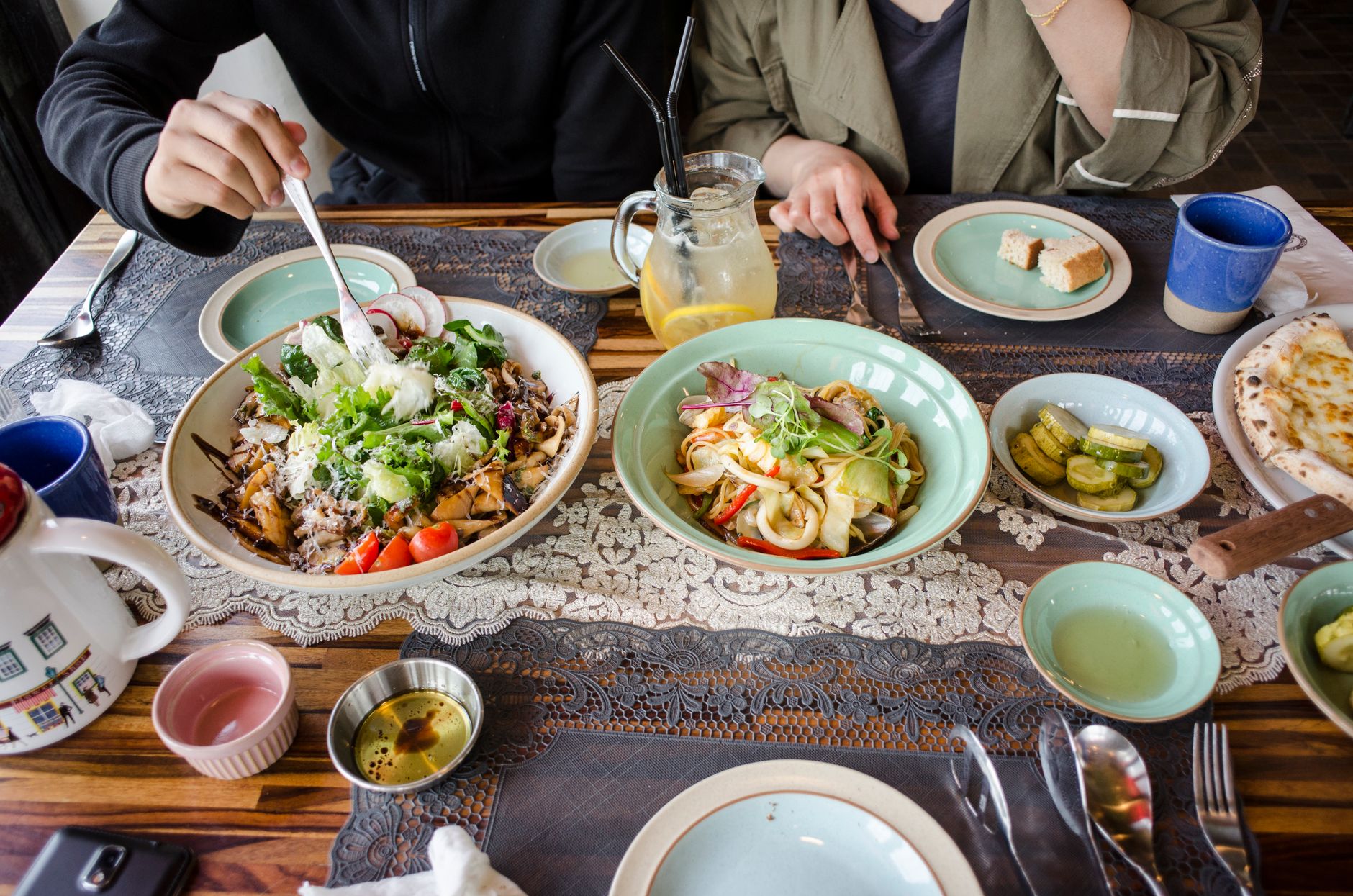 High-angle view of a vibrant meal with fresh salads, drinks, and diverse plating. (Photo: makafood / Pexels)
Frequently Asked Questions (FAQ)
Q: Is food travel worth doing solo?
A: In many cases, solo is actually the advantage. Japan and Taiwan in particular have deep counter-seat cultures and solid solo-dining infrastructure. Counter seats are often easier to book for one, and sitting close to the chef makes the entire experience richer. Market crawls are also better alone — you can sample small amounts from many stalls without negotiating with anyone. When booking, set the party size to one on Google Maps or the reservation platform to filter for solo-friendly restaurants.
Q: The line at a famous restaurant is enormous. Do I have to go?
A: There's no "have to." But before giving up, try timing strategies first: arrive 30 minutes before opening, target the first post-break seating, or visit at off-peak hours like 11 a.m. or 2:30 p.m. If the wait is still over an hour, move to your pre-selected Plan B restaurant. A two-hour wait doesn't just cost two hours — it consumes an entire meal slot of your day. Factor that into the math.
Q: How much should I budget for a food-focused trip?
A: The standard approach in food travel for foodies is to raise the food share of your budget to 40–50% of total trip cost — well above a normal vacation. For a 2-day domestic trip, that might mean $100–150 of food within a $250–350 total. For a 4-day international trip to a city like Osaka, Taipei, or Bangkok, expect roughly $300–500 of food within a $900–1,200 total. Fine dining swings the ceiling dramatically, so set the budget for your one "peak meal" first, then distribute the rest.
Q: What if the local food doesn't agree with me?
A: Risk management starts before departure. Research the flavor profile of signature dishes ahead of time — spice levels, sweetness, fermented notes — and save a few local phrases for adjusting orders, like "no cilantro" or "less spicy." In Thailand, for instance, "mai sai pak chee" (no cilantro, please) is famously useful. Also scope out a familiar restaurant or convenience store near your hotel as a psychological safety net. The beautiful thing about food travel is that even after one disappointing meal, the next one is only hours away.
Final Thoughts
Here's the core of food travel for foodies, distilled: choose destinations by signature dishes, dining spectrum, and seasonality; build itineraries with meals as the skeleton; ration your appetite with the five-meals-a-day strategy; and find restaurants by cross-checking local platforms. Add digestive aids and a Plan B, and your preparation is complete.
A perfect food trip isn't measured in Michelin stars — it's completed by the single meal whose memory still lingers on your tongue long after you're home. If you've got a saved list of restaurants sitting in your maps app right now, start small with a weekend trip this month. The moment you open the map and pin that first restaurant, your food travel has already begun.