
Culinary Travel: The Complete Foodie Trip Planning Guide
Plan the perfect culinary travel itinerary: local food routes, top international food cities, booking tips, and smart budgeting made simple.
The Complete Guide to Culinary Travel: Iconic Food Destinations and How to Plan the Perfect Eating Trip
If you find yourself searching "what should I eat there?" before "what should I see there?", congratulations — you're already a culinary traveler. Somewhere over the last few years, the center of gravity in travel quietly shifted from sightseeing to tasting. The trophy shot in front of a famous landmark has been replaced by a single, hard-to-book meal at a tiny local restaurant that becomes the emotional peak of an entire trip.
For a growing number of travelers — especially couples and professionals in their twenties through forties — "I'm flying to that city because of one restaurant" has become a completely normal way to plan a vacation. The catch is that culinary travel is genuinely harder to plan than a standard trip. You have to track reservation windows, build a waitlist strategy, and choreograph how many meals to eat per day and in what order.
So this guide walks through culinary travel planning from start to finish: how to design a food-first itinerary, which world-class eating cities are worth the flight, how to build a realistic budget, and how to keep a record of every great bite. Read it once and you'll have everything you need to plan your next food-forward adventure.
What Is Culinary Travel? 3 Ways It Differs From a Normal Trip
Culinary travel flips the usual planning order on its head. The first difference is that reservations become the backbone of your itinerary. On a normal trip, you map out attractions first and squeeze meals in around them. On a food trip, you lock in your meals first — "sushi counter at noon, tasting menu at seven" — and then arrange everything else in the gaps between them. Your reservations are your itinerary.
The second difference is that food determines where you go at all. A culinary traveler doesn't eat the local specialty simply because they happen to be in town — they book the trip for that specialty. The dish comes first, the destination second. This "travel for a single meal" mindset dovetails perfectly with a younger generation's appetite for spending on experiences rather than things, and it keeps spreading.
The third difference is an inverted budget. On a standard vacation, lodging usually eats the biggest slice of the budget. Culinary travelers do the opposite: they book a clean, no-frills hotel and pour the savings straight into the food line. On a serious eating trip, spending more on a single day's meals than on the hotel isn't strange at all — it's the whole point.
 Close-up of a vibrant Monstera leaf in a pot indoors in Đồng Nai, Vietnam, emphasizing lush greenery. (Photo: Vui Nguyen / Pexels)
5 Iconic Culinary Travel Destinations Worth Building a Trip Around
① San Sebastián, Spain — the pintxos capital. Start the morning strolling the Old Town, spend midday hopping bar to bar for pintxos (the region's elevated version of tapas), and cap the evening at one of the city's astonishing number of Michelin-starred restaurants. Distances are short and walkable, which makes it ideal for travelers without a car — you can eat your way across the entire city on foot.
② Bologna, Italy — the pantry of a nation. Skip the tourist checklist and follow the ragù. Begin with fresh tagliatelle at a family-run trattoria, spend the afternoon touring the market stalls of the Quadrilatero for cured meats and Parmigiano, then settle into a long, wine-soaked dinner. Bologna rewards travelers who treat lunch and dinner as the day's two main events.
③ New Orleans, USA — where cultures meet on a plate. Open the day with beignets and chicory coffee, graze through po'boys and gumbo at lunch, take a walking break through the French Quarter, and finish with Creole fine dining. Few cities pack this much culinary identity into such a compact, strollable footprint.
④ Oaxaca, Mexico — a living food heritage. Beyond mole and tlayudas, Oaxaca has a steadily growing scene of chefs reinterpreting indigenous ingredients through a modern lens. Pair a night at the bustling street-food markets with a reservation at a contemporary tasting room and you'll experience both ends of the spectrum in a single day.
⑤ Tokyo, Japan — from humble noodle counters to three Michelin stars. Ramen for breakfast, a department-store food hall at midday, an afternoon snack crawl, and an omakase counter at night are all on the table. The density of legendary hole-in-the-wall spots and world-class restaurants makes Tokyo one of the best places on earth to start your culinary travel journey.
Comparing Accessible Foodie Cities: Tokyo, Osaka, Bangkok, and Taipei
For travelers based in or near Asia — or anyone willing to trade a longer flight for extraordinary value — four cities stand out as culinary travel pilgrimage sites.
Tokyo is widely regarded as having one of the highest concentrations of Michelin-starred restaurants of any city in the world, making it the spiritual home of fine dining and sushi omakase. The trade-off is cost: it has the steepest average meal prices of the four, and a proper omakase can easily run into the hundreds of dollars. But the quality-to-effort ratio is unmatched.
Osaka lives up to its nickname as "the nation's kitchen," with street food like takoyaki, okonomiyaki, and kushikatsu as its calling card. Meals cost noticeably less than in Tokyo, which makes it perfect for a casual, high-energy eating trip — and Kyoto and Kobe are both close enough to widen your culinary radius.
Bangkok is the city of range and value. A bowl of street-side noodles costs pocket change, while internationally acclaimed fine dining can be enjoyed at prices that feel remarkably reasonable compared to Tokyo or major Western cities. With a longer flight time, it suits a stay of three nights or more.
Taipei is the pinnacle of night-market culture. At the Shilin and Raohe markets you can knock out beef noodle soup, bubble tea, and grilled skewers one after another, all while spending very little. It's an ideal, low-pressure entry point into culinary travel.
Platform strategy varies by region. In Japan, locals lean on Tabelog scores (anything above roughly 3.5 is considered solid). For Bangkok and Taipei, cross-referencing the Michelin Guide with recent Google reviews is the most reliable way to cut your odds of a miss.
How to Build a Culinary Travel Itinerary: Reservations, Waitlists, and Routing
Three things make or break a food-focused schedule: reservations, waiting strategy, and routing.
Reservations come first. Popular restaurants often open their books on a fixed schedule — one to three months out, on a specific date. Look up each target restaurant's booking rule (first of the month, exactly 30 days before your visit, and so on) and set a phone alarm. To fight no-shows, many places now require a deposit or a card on file, so put the cancellation policy — how many days ahead you can cancel for free — directly on your checklist.
The single best money-saving move is the lunch menu. Countless top restaurants serve the same kitchen and the same chef's cooking at lunch for roughly half the dinner price. Book fine dining for midday and save the evenings for casual, iconic, market-style spots. You protect both your budget and your satisfaction.
For routing, follow the "two meals a day" rule. Trying to fill breakfast, lunch, and dinner all with destination meals leaves you too full to actually taste the last one. Leave four to five hours between lunch and dinner and fill that window with a market walk, a coffee break, or a stroll. On a well-designed culinary travel day, walking doubles as both your digestion and your sightseeing.
Culinary Travel Budget Guide: From a Weekend to a Four-Night Trip Abroad
Domestic weekend (per person): Round-trip regional transport at roughly $60–90, one night in a business hotel at $60–90, four meals including one fine-dining lunch at $90–140, and snacks and coffee at $25–40. That lands you around $235–360. If food accounts for 40% or more of the total, you've got the classic culinary travel budget split.
Short-haul international, three nights (Tokyo example): Round-trip airfare at $220–380, three nights of lodging at $220–330, food at $300–450 (assuming one or two omakase or fine-dining meals), and $70 or so for local transport and extras. Total: roughly $800–1,200. Choose Bangkok or Taipei instead and lower food and lodging costs let you hit the same level of satisfaction for around $600–900.
The allocation principle is simple: cut costs on lodging and transport, and protect the food budget. Define your hotel as "a place to sleep" — a clean, well-located room is more than enough. Then, once or twice across the whole trip, spend boldly on a meal you'll remember for years. In culinary travel, your satisfaction isn't set by the average; it's set by the peak.
How to Document Culinary Travel: Photos, Reviews, and Your Personal Food Map
The foundation of good food photography is natural light and a 45-degree angle. Request a seat near a window, shoot the plate from about 45 degrees, and most dishes will come alive. For soups or elaborately plated courses, an overhead shot works beautifully. But manners come first: turn off the flash, finish shooting within 30 seconds of the dish arriving, and at counter-seat omakase spots — where photography is sometimes restricted — ask before you shoot. Consideration for the chef and the other guests is a core skill of any culinary traveler.
Your key documentation tool is a saved-places list in your maps app. Keep two separate lists — "want to go" and "been there" — and for each visited spot, add a star rating plus a one-line note: would you return, what to order, how hard was the reservation. Over time these lists become a personal food map for each city, and they cut your planning time for the next trip in half. Better still, when a friend heads to the same city, you can hand over the entire list with a single share.
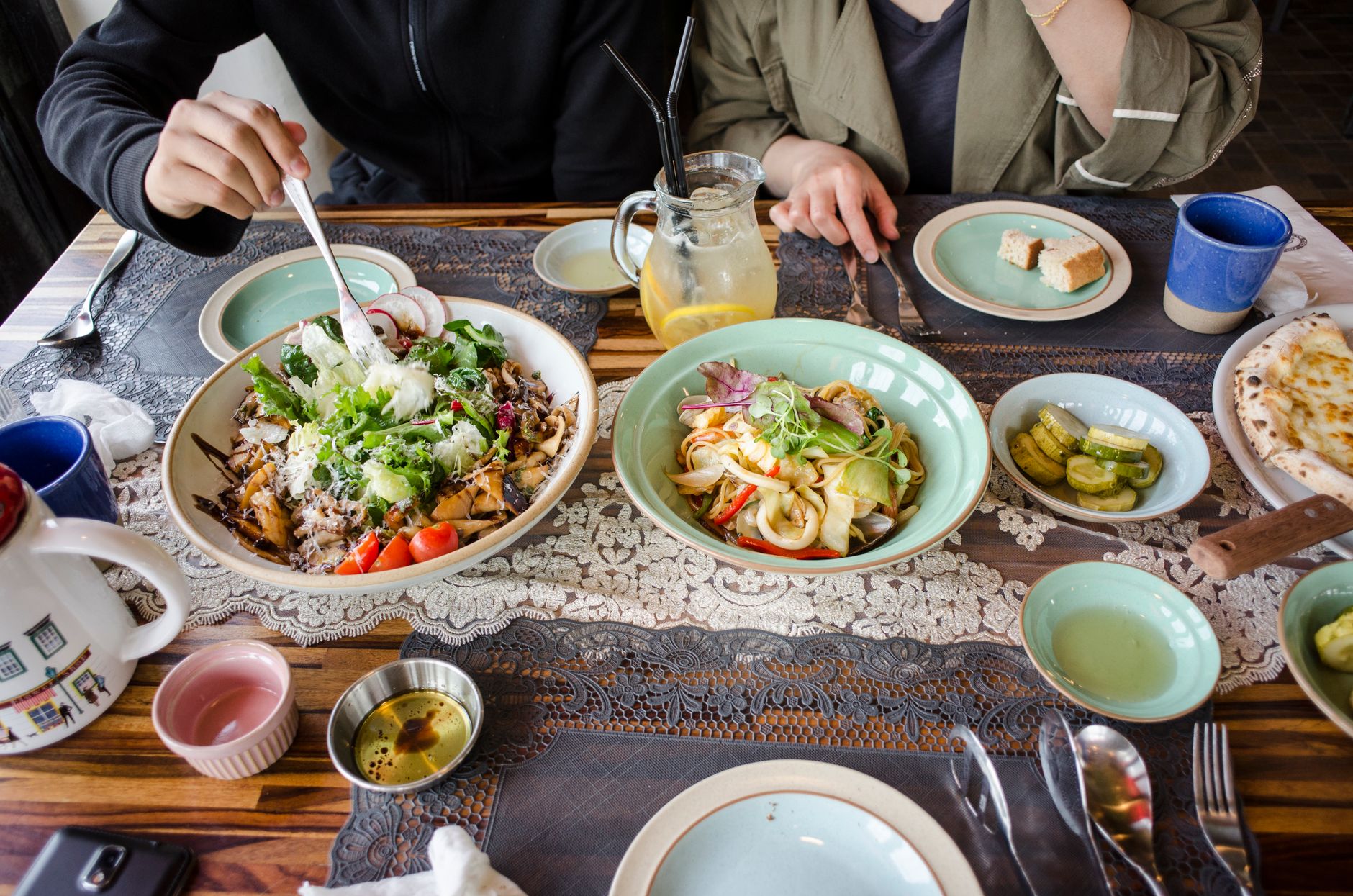 High-angle view of a vibrant meal with fresh salads, drinks, and diverse plating. (Photo: makafood / Pexels)
Frequently Asked Questions (FAQ)
Q: Is culinary travel okay to do solo? A: In many ways it's actually better. Omakase and bar-style counter restaurants are built to welcome solo diners, and even popular spots hold single seats that are far easier to book. Market crawls are perfect alone, since you can taste a little from many stalls. If eating solo feels awkward, start by building your itinerary around counter seats.
Q: How much should I budget for a culinary trip? A: A domestic weekend typically runs $235–360, while a short-haul international trip of three or four nights to a city like Tokyo or Bangkok generally lands around $800–1,200. But the total matters less than the split. Aim to make food 40% or more of your spending and trim lodging and transport, and the same budget will deliver a dramatically better experience.
Q: What's the backup plan when I can't get a reservation? A: Build a triple-layered Plan B. First, turn on same-day cancellation alerts in reservation apps — seats open up more often than you'd think. Second, use a waitlist app to hold a remote spot in line and wait nearby. Third, target the chef's second, more accessible restaurant, or hit the easier-to-book lunch service. All three are legitimate detours to a great meal.
Q: Where do I find accurate information on culinary travel destinations? A: Don't trust a single platform — cross-checking is the answer. Shortlist candidates using established guides like Michelin, then confirm with local sentiment via Tabelog in Japan and Google reviews elsewhere. If recent reviews all cluster around one date or read suspiciously alike, they may be promotional. The most accurate filter is reading the low-star reviews to see whether the complaints describe something you can personally live with.
Final Thoughts
Boil culinary travel down to a formula and it looks like this: put reservations at the center of your itinerary, route your day around the two-meals rule, invest in food instead of lodging, and record every place you visit on your maps app. Follow just these four principles and the density of your trips will change completely.
If you're staying closer to home, pick one accessible destination for an easy weekend. If you're heading abroad, start with a low-pressure city like Osaka or Taipei before graduating to the more demanding reservation gauntlets. This weekend, take the first real step: look up the booking date for that one restaurant you've been dreaming about. Here's to a future where your next trip begins not with "what should I see?" but with "what should I eat?"